
Start a DME Business in 2026: The Full Roadmap
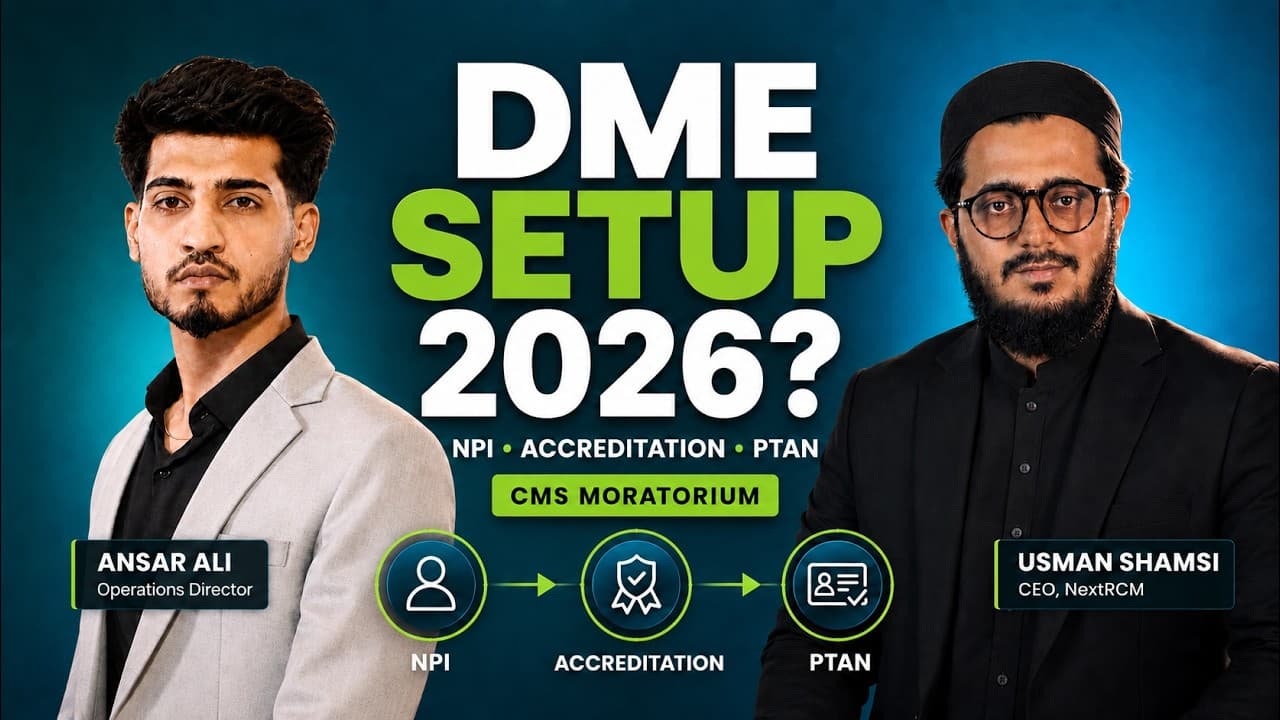
Presented by Usman Shamsi
Published: Length: 1:08:04Spoken in Urdu and Hindi, with English captions
Starting a DME business follows a fixed order, and billing comes last: form the company, get an EIN and a Type 2 NPI with the right taxonomy, obtain the state license and accreditation, secure the surety bond and liability insurance, and enroll in Medicare through PECOS with the CMS-855S before setting up documentation, claims and payer contracts. In this edited live masterclass, Usman Shamsi walks through each step with questions from aspiring DME owners, plus the compliance red lines and why inbound referrals beat outbound calling.
Chapters
Select a chapter to play the lesson from that point.
- 0:00Coming up: the DME roadmap in 30 seconds
- 0:32Why you need the full DME roadmap
- 2:18What DMEPOS covers
- 3:57Legal setup, EIN and NPI
- 8:11Taxonomy and state licensing
- 11:01Accreditation
- 12:23Surety bond and liability insurance
- 14:39Medicare enrollment and PECOS
- 18:53Orders, medical records and addenda
- 22:36Claims setup: 837P, CEDI and ERA
- 26:13HIPAA-safe tools and date of service
- 31:55Getting in-network with private payers
- 35:14Out-of-network billing and the PTAN
- 37:13Cash pay, Medicare and Medicare Advantage
- 39:57Using AI for documentation research
- 41:52Delivery proof and site readiness
- 45:20Medicare enrollment step by step
- 47:29Commercial, MA and Medicaid credentialing
- 50:05Compliance basics and audit readiness
- 53:22What a DME coder checks
- 54:17Order intake, eligibility and prior auth
- 57:49Documentation, coding and billing
- 1:02:38Growing a DME the compliant way
- 1:05:24Why outbound marketing is risky
Updates since recording
- Correction, 29:29 to 30:45: Any DME supplier that ships through a shipping or delivery service, not only DDP or McKesson drop-ship orders, may use the shipping date as the date of service on the claim (or the delivery date). Keep the carrier's tracking record as proof of delivery. Source: CMS LCD article A55426, Standard Documentation Requirements
- Update: Suppliers with a Medicare enrollment date or ownership change effective on or after October 15, 2026 must get prior authorization before delivering any item on CMS's Probationary Prior Authorization List, during a one-year probationary period. Source: CMS, Probationary Prior Authorization Process
- Update: Round 2028 of the DMEPOS Competitive Bidding Program: bidder registration opens December 1, 2026, and the bid window opens January 5, 2027. Source: CMS MLN Connects, October 8, 2026
- Update: Since January 1, 2026, DMEPOS suppliers must be surveyed and reaccredited at least once every 12 months. Source: Federal Register, final rule of December 2, 2025
Full transcript
English translation of the Urdu and Hindi audio, taken from the English captions published with this video on YouTube.
Show the full transcript (10,338 words)
0:00Coming up: the DME roadmap in 30 seconds
…is mandatory. Accreditation. When we reach this stage, remember, accreditation is the most challenging part. So, Medicare's, CMS's, criteria is this: we'll pay you right now, we're trusting you. They're relying on that. Then they say, we'll check later. Meaning, we'll pay you now, and later we'll check whether what you filled in the form is accurate to what's in it. Obviously, when an auditor comes to audit, what they look at is, how did the patient come to you? Did you call the patient yourself? I hope you're all doing well.
0:32Why you need the full DME roadmap
Without any delay, let's try to start this session. So, the goal is to understand the DME roadmap and the DME business really well. In this, I've tried to add almost everything related to DME, and for some things, the important ones, we'll try to go into detail. So, basically, first of all, I want to tell you something. What I've mostly seen is that people working in the DMEPOS industry don't have much real knowledge of DMEPOS. Their knowledge is very limited, and because of that... half-knowledge of anything is worse than having no knowledge at all.
Until you understand the entire function and the entire system, you'll have trouble making decisions later on, and the industry and the market will be hard to understand too. And when you don't have this knowledge, you'll never be able to make a good decision on time. Right? So first, let's try to understand, when we set up a DMEPOS, I mean, when we want to start a DMEPOS business, what do we have to do first?
2:18What DMEPOS covers
First, as you all know, since you're all from the DME industry, DME is durable medical equipment, prosthetics... supplies. In it, first come the classic products, which include mobility equipment: wheelchairs, rollators and so on. And besides that, in medical equipment, you could say, medical equipment includes other devices, like BPM, CGM, CPAP, BiPAP. And one difference between prosthetics and orthotics you should understand: orthotics are always devices, like braces, that go on the outside of our body, which we adjust. And prosthetics are devices that go inside our body, like intermittent catheters.
They go inside, so they automatically fall under prosthetic devices. Okay? And then there are wound care supplies, nebulizers, humidifiers, and also braces, compression stockings, and lots of durable hospital beds. But what I've mostly seen is that people in our industry working in this segment work in just two products. One is braces, and the other is CGM. They work in braces probably because the reimbursement is good, and they work in CGM because it's a continuous, recurring supply, so a refill goes out every month. That's also a reason people work in CGM.
3:57Legal setup, EIN and NPI
So first, if you want to run a DME business, then to do a DME business, first you'll need a legal setup, meaning you'll need to form a company, and you'll have to decide what type of company to form. A limited liability company, which is called an LLC, or a corporation? Right? Or form it as a partnership, or keep it as a sole proprietorship. And whenever we form a company, you have to remember, whenever we form an LLC, we have to do a federal registration, meaning a company is always tied to the federal level too.
Okay? State licensing comes later. First, we form the LLC. For that, later on we'll also see that we need a manual for it. Okay? After that, the LLC is formed. For an LLC, you just go and file. You also need an agent for it. You need an agent, and you can easily find one you can use. The reason is that, basically, your agent... if any paper document related to your LLC comes in, or any other legal document, it goes to them as well. Okay? That's basically the agent's purpose.
And they're, you could say, licensed agents. Okay? And after that, as soon as your LLC is formed, first you have to apply for a tax ID, meaning an EIN number. You apply for it, and the company's, the LLC's or corporation's EIN number is issued, which is also called the tax ID. Now, this tax ID is just like a person's Social Security number. Since we're in Pakistan, just like we have an ID card, an NIC, in the same way, the company's NIC, its Social Security, is its tax ID.
Okay? So we get that tax ID. After the tax ID, we apply for the NPI. Now, people make a mistake here. They get the NPI from NPPES. This is the provider identification that every kind of health provider basically has to get. NPPES is basically a federal government organization that issues the NPI. And here, the mistake people make is that, often, they don't know, so they get a Type 1 NPI, and with a Type 1 NPI... one thing you need to remember. The usual mistake is this.
Look, always remember, later when we're billing, when the whole DME is set up and we're maintaining our CAQH profile, and we've received our Medicare number and our Medicaid one too, and we're covering dual patients, if on our incorporation, our address, our name, our doing-business-as and our legal name differ from any document, then first, look, a change of information takes a lot of time. Keep in mind it takes 45 to 50 days. If you need an address change on your tax ID from the IRS, or a name change, it takes 45 days.
The details on the incorporation, the details on our company's incorporation, those same details should be on our IRS, on our tax ID, exactly the same. Not a single spelling mistake, or later you run into issues, in billing too, and the insurance provider can't find us, can't locate us in its system. On the NPI as well, the Type 2 NPI details should be exactly the same. same details, same address, same physical address, same billing address. Everything should be the same. Okay? Now, let's talk about taxonomy. The mistake people make in getting a taxonomy is that they take the one DMEPOS taxonomy, but if you need to do custom work, or, for example, in Medicaid there are many programs where you can provide ambulance services, and besides that, there are different acute care services.
8:11Taxonomy and state licensing
Then for those, the DMEPOS-eligible taxonomies are different. You then have to get those added in NPPES too. And once you add them in NPPES, then of course you'll have to change it in your Medicaid enrollment as well. And if in Medicare you're rendering a service for which, besides the main DMEPOS taxonomy, you need a specialized taxonomy, then after changing it in NPPES, in our PECOS portal, we'll go in, file a change of information and add the taxonomy there. Okay, now let's talk about state licensing. State licensing is the third step.
Now we're moving to the state level. First, what did we do? We got our tax ID, and after that we got the NPI, Type 2, and after that we got the taxonomy, and after that we'll move to state licensing. Let me give you an example. In Texas, the state license we need is a device distribution license, the device distribution license, which is also called DSHS. Okay? Without it, you can't bill some commercials. Even for Medicaid, when you're doing the enrollment, it's required then, and besides that, Blue Cross Blue Shield also requires it.
And besides that, if you don't have it, you can't do pneumatic compression devices, and CGM falls in that too. Okay? So in the same way, since this is state licensing, state licensing is different for every state. This DSHS license, you won't see it in Illinois. The license you need in Illinois is an HME license. Okay? So this is called, you could say, a state license, and it's also called a DME license. And it's not necessarily the case that just one DME license is enough. If you're specializing, like supplying oxygen, in some state, then besides the state's DME license, there may be a different specialized license you'll have to get.
Most licenses I've seen, and the ones I've gotten, DSHS and HME, in Illinois, it's roughly $350 to $400, but in Illinois it's valid for one year, and in Texas, the DSHS expiration is about two years. Okay? And after two years you have to renew. These licenses run roughly under $1,000, and they expire in one or two years. So getting a state license is necessary, because later, when we move toward enrollment or toward accreditation, having a state license is mandatory for that.
11:01Accreditation
Accreditation. When we reach this stage, remember, accreditation is the most challenging part. Before, accreditation used to happen very easily, but now Medicare has made the accreditors, its third-party private contractors, much stricter, and because of that they ask for a lot of extra things in their survey, and many more deficiencies come up. So the basic purpose of accreditation is your, your physical DMEPOS office, or your storefront, validating that whatever products you're doing, whether it's CGM, braces, CPAP or BiPAP, compression stockings, or TENS units, whatever product you're doing, you're following all the SOPs, and you are competent to provide that product to the patient, and your place meets Medicare's, CMS's DMEPOS standards exactly.
So basically, accreditation is like in a lab, where tests get validated. The survey done in a lab is often called validation. In the same way, in DME we have accreditation. Okay? And without accreditation, we... the Medicare application.
12:23Surety bond and liability insurance
Now, the bond and liability insurance, let me explain. The thing with the bond is, the $50,000 bond needed for Medicare is separate, and for Medicaid, the $50,000 surety bond you need is separate. People often make this mistake. Clients think one bond will work for both. One bond doesn't work. … So if it's good, then you can get it for $250 to $500 for one year. What's the purpose of the bond? The bond's basic purpose is that if you've done something to Medicare or Medicaid, then at least they have your $50,000, and that $50,000 of yours they take straight out of your bond.
That's basically the purpose. It's a surety, given by a third-party company to Medicare, the one you get the bond from, an insurance company, that if any problem happens, meaning any fraud activity, or waste or abuse, anything in the categories CMS has defined, then this $50,000 surety bond, they'll cash it. And with that, of course, your credit score can also get damaged, and it absolutely can. People have this confusion; people ask me, brother, isn't the LLC there so that our personal side isn't affected? It's a wall between our personal liability and our company's liability.
Well, the LLC's very first role is exactly that: the LLC protects your personal assets as long as there's been no fraud, waste or abuse. If there's fraud, waste or abuse, the LLC's wall gets broken, and then it comes onto your score. You'll have to remember that. Now, liability insurance. The liability insurance, from $300,000 up to $1 million, that you need, works for both Medicare and Medicaid. It can cost you from $800 to $1,500, roughly, whether you want it for one year, two years or three years.
14:39Medicare enrollment and PECOS
Okay. So, you've formed the LLC, you have a tax ID, you got the Type 2 NPI. Type 1 is for individuals, Type 2 is for organizations. You got the Type 2 NPI, the taxonomy. State licensing comes in about seven to ten days. Just a few days ago we did a DSHS, and maybe ten days in, the state license came through, for a DME. Okay, accreditation. Accreditation is a long process. It takes quite a lot of time. First of all, you have to complete the whole manual, and follow all the accreditation steps.
Then you request the survey, and after the survey request, they take two months, and then approving it can take an additional month. So without accreditation, you can fill out the whole form, I mean, for Medicare and Medicaid, I mean, you can fill out the whole enrollment form, but you can't submit it, because without accreditation the enrollment can't happen until the accreditation certificate is there. People also make a mistake here. Look, at the start you have the chance to add as many products as you want, the ones you'll do.
Get them added at the start. Later, when you go to add them, they'll charge you extra and it'll take time too. And then you've got an order in hand, so your profit margin is suffering. But most people only have accreditation for CGM and braces. Nothing else, no wheelchairs, or urology supplies, which include ostomy pouches, incontinence supplies, which include diapers, which Medicaid also covers, and besides that, the different durable medical equipment, prosthetic and orthotic products, they don't have accreditation for those, so they can't do them, because whichever products you're accredited for, at the time of Medicare and Medicaid enrollment, you have to enter those same products in the form, and only those will be approved, and only those you can provide.
Okay? Then your accreditation gets approved, you got the surety bond, you got the liability insurance, and then you move to payer enrollment. Then you'll create a Medicare account in PECOS, where all provider enrollment in the Medicare program happens, inside PECOS, whether it's a lab, a DMEPOS, a nursing home, a hospice, or a clinic. PECOS is basically their enrollment system. Since we're only talking about DMEPOS, for DMEPOS you'll start the enrollment form, and the form has to be filled very carefully. No mistakes, no deficiencies in it.
You have to try to fill it in exactly the right way. It's a very lengthy form. To fill it, even the best consultant needs a week, a week and a half, two weeks to fill out the Medicare application, because all the documentation and everything has to be filled in, and for whoever is named, whoever we're making managing employee and owner, their driver's license is needed, the Social Security number is needed, the residential address is needed. Basically, every detail except their marriage certificate, and there are disclosures on it too.
So then you do the payer enrollment, it gets approved. Payer enrollment, Medicare approved. Then for eligibility, the CGS account, you can't create it yet. Once Medicare is approved, the CGS account gets created. When we sign up for CGS, you may have seen, what we have to do is enter the last billing we did, the invoice for it that we received, we have to enter that. Okay? That's why one to two claims have to be billed before our CGS account gets created. Now people ask, sir, do we need prior authorization?
Because this moratorium has reopened. One or two breakers, speed bumps: when they suffer losses and bad providers bill the wrong way, then they take some step to stop it. So this time, the step they took is that any new provider, for about a year, must get prior authorization, even for products that don't require prior authorization. Why?
18:53Orders, medical records and addenda
Look, Medicare's policy is this: Medicare says, we'll pay you and check later. The reason is that they care about this: if we put it all on the provider up front, like, collect the documentation first, then submit it to us, and then we'll pay, then the patient's care could be delayed a lot, and the patient could... I mean, for instance, let me give an example: someone has had surgery and needs a brace, or they could have hypoglycemia, they could get dizzy, so a CGM is very important for them, so that there's monitoring, ongoing monitoring.
So if it takes two weeks, three weeks for that product to reach the patient, and they have a big problem, I mean, if they get a severe issue, Medicare's cost will double or triple because of it. Then, you see, they'll be admitted, Part A will be active too, with separate charges. Then they'll come to a rehab center, which costs extra. Then under a home health agency, they'll need home health services, and that costs extra too. So Medicare's, CMS's, criteria is this: we'll pay you right now, we're trusting you, that the ICD codes you put on the claim form, the diagnosis codes, and the HCPCS codes you entered, you gave that same item to the patient, and the patient has the same diagnoses you entered.
CMS is trusting you on everything, the form you're filling, they're relying on it. Then they say, we'll check later. Meaning, we'll pay you now, and later we'll check whether, based on the form you filled out, the HCPCS and modifiers you used, were all the guidelines actually met for that specific product, those guidelines, fully? If you've entered a diagnosis code, a diagnosis code, does it appear in the face-to-face sheet, the chart notes, the progress notes or the addendum, or not? Second, what I've mostly seen is that people put, in the SWO, diagnosis codes.
Whereas, if you... Medicare's... if you read CMS's policy on the SWO, the standard written prescription order, if you read the policy, they have no value in it. ICD codes aren't even required in it. The SWO doesn't require them at all. The ICD code's validity can only be established either from a face-to-face encounter, when the patient comes to the doctor's office and a face-to-face sheet is made, an encounter is created; it can be in chart notes, or in a home health agency's detailed home notes, it can be in those, or otherwise in the progress notes.
Or else, if you found something like that somewhere in the chart notes... CMS has already banned that. Any such letter won't be accepted now, meaning in auditing, or when you go on to appeals, they don't accept this medical necessity form. But an addendum they accept. But between an addendum and a CMN, this certificate of medical necessity, there's a difference. An addendum means that in the chart note, some one thing is visible that, if you zoom in on it, gives us a relevant diagnosis code, on the basis of which the HCPCS becomes eligible. Okay? I mean, an addendum can't be about something novel that isn't reflected in the chart notes.
22:36Claims setup: 837P, CEDI and ERA
Okay, in this session, the CMS... I'll do my best to show you a CMS- 855S form too, how to fill it in, because people needlessly hire a biller, and the biller already has so much work that they end up delaying things. People needlessly think it's so hard, even though there are ten thousand videos on YouTube about it. Filling out the 855S form is so easy, which electronically, 837P... Now, how is EDI set up? Okay, EDI: to submit electronic claims, to send claims to Medicare electronically, you have to get your EDI enrollment done.
So how does EDI enrollment work? First, Medicare has a form, the EDI form, which you have to fill out and submit, and it gives you a reference number, and on the basis of that, you can choose any clearinghouse. For example, whatever EHR you're using, let me give an example, Charm EHR has a clearinghouse, Optum. Okay? Optum is its clearinghouse. So, Optum. Now, what is a clearinghouse? Think of a clearinghouse as a middleman, whose job is that whenever you submit a claim, it does an initial screening to see if your claim has any initial issues. it runs it through 10, 12, 15 checks so that neither your time is wasted nor the payer's time.
So it does an initial screening. That's basically the clearinghouse's job, and it's the clearinghouse that electronically submits the claim onward to the payer's relevant department, and to different payers. Like now, with the Optum clearinghouse, you first did the CEDI enrollment. After CEDI enrollment, their EDI enrollment, to do it you'll first have to enroll for their professional claims, the professional enrollment, and you'll create your portal. After creating the portal, first, for professional claims, you have to do the EDI enrollment. Okay? And if, say, you're doing work for a hospital, the UB form, which is the institutional claim, has a separate enrollment.
That too, if you're using Charm EHR, is through their clearinghouse, done by creating an Optum account. But before creating the Optum account, you have to create a One Healthcare ID, a One Healthcare ID. For that, you'll go to the portal and create the One Healthcare ID. It takes minutes. Then, with the One Healthcare ID, Charm EHR will give you your organization ID. The CEDI enrollment you'll have done already; that takes a day or two. And after that you'll come to Charm's Optum, and once on Optum, you'll do the professional claims enrollment, and along with it, all...
The professional claims enrollment is separate for each jurisdiction: A, B, C, D, each jurisdiction separately. If you only want your own state's jurisdiction, just do one enrollment. If you want all states, do all the states. I mean, within the four jurisdictions all states are covered. For ERA, meaning the remittance advice, so that your ERA arrives directly and automatically, and you don't have to go to Optum and claim it. Now, the mistake people make, I've often seen, is that when they're using Availity or Office Ally, with the EHR they're using, they haven't done the ERA enrollment, and because of that, all their payment posting, accounts receivable, and the ERAs and EOBs coming in have to be checked manually.
This system is your clearinghouse. Like I'm talking about Optum, Availity is itself a clearinghouse. Okay? Office Ally has its own clearinghouse. So, after doing the enrollment, whatever EHR you're using... And an EHR basically is where you manage your entire practice.
26:13HIPAA-safe tools and date of service
It can be done on Google Sheets too, but a Google Sheet that's on a personal Gmail isn't compliant. It isn't HIPAA compliant. For that, what you have to do is, from Google Workspace, you have to create the Google Sheet, and then go into its settings, where there's a BAA procedure, meaning you have to sign a BAA with them, and then it becomes HIPAA compliant, fully compliant. And the accreditation surveyor now checks this too: if the Google Sheet is on a personal Gmail, not on Workspace, then they catch it.
So, the EHR, I'm coming to the EHR now. The benefit of an EHR is that things happen automatically. For instance, you did intake for a patient. The benefit is you put everything in there, and then it also has OCR options, so it pulls the relevant diagnoses from the chart note by itself. Then billing happens there too. You don't need to go into Availity to bill. To all the payers, from your one EHR, they'll go out, and then the remittance advice will come in, and it'll come right into the same EHR, and payment posting happens in it too.
If you need to charge the patient coinsurance, in Charm EHR, they have a Bluefin account, which you have to enable. Patient coinsurance is, you charge the patient, the patient pays, and we have to manage their account receivables. And waiving it isn't compliant either. Patient responsibility: you must ask the patient for it, and then if the patient doesn't pay, then there is no problem, but if you are routinely, I mean, waiving coinsurance, then it's a big problem. When there's a survey later, or the accreditation survey comes, if they see that you haven't maintained your log, then they might reject your survey, and because of that your survey cost, $2,000 or $10,000, could be wasted.
Okay? So, your EDI enrollment is done. After the EDI enrollment, after EDI, you'll fully set up your Charm EHR, whatever EHR you're using. I mean, in the back end you enter all the organization settings, the payer settings, and besides that, you add ICD codes, you add HCPCS codes, and besides that, the fee schedules for HCPCS codes have to be added, so things get automated. I mean, you just select a HCPCS code, select the ICD, and automatically the claim is built. You just click and it's submitted electronically, passing through the clearinghouse.
And of course, before that, you'll do the delivery, and then move to billing. Now, the mistake people make is that they bill first and then, afterwards, they deliver. That's wrong. Look, the SWO is one such thing; they also call it SWOPD, meaning it has to be prior to delivery. The written order you have should be prior to delivery. And the proof of delivery, the proof of delivery, you basically have to get it before you bill. Okay? Now, one thing to remember about DDP and McKesson. Let me explain something: when people ship from DDP and McKesson, then on DDP and McKesson, the delivery date that shows up, the date you dispatched the order, you can make that the date of service too.
The date of service goes on the claim in three or four places. It's the most important thing, because when audits happen, whether it's a CERT audit Medicare has four or five contractors with different audit responsibilities. First comes CERT, then RAC, then SMRC, and then the UPIC, as it's called. It looks into waste, fraud and abuse cases closely. And before that, CERT basically checks proper and improper billing, because every year it has to publish its figures. Like last year's... RAC and SMRC each do separate audits. I'll tell you about this later too.
The point is, if you're shipping from DDP or McKesson, then the date it shipped, even though the patient hasn't received it yet, the patient hasn't gotten the product, your date of delivery can become the date of service. But I'm only talking about McKesson here, and I'm only talking about DDP. But if you're shipping to someone from your own DME, I mean, using a courier service, say in your DME you have a walker or quad cane sitting there, and you ship it, until it arrives, there's no proof of delivery, so you can't bill.
You have to remember this. Okay? It'll come, the ERA will come automatically into your EHR, and the account receivables will be done too. So now, let's documentation control, revenue... let's try to understand that. Let me have some water. If there's anything, you can ask. Raise your hand and ask. Look, the thing with EDI enrollment is that it's separate for each payer. Now, it's possible that in Office Ally the payer settings you did, the EDI enrollment you did, was only for Medicare, or not for Medicare but only for Blue Cross Blue Shield.
Okay? And look, EDI enrollment has to be done separately for each payer. Blue Cross Blue Shield will be separate, Humana separate, UHC separate, and every payer's EDI enrollment will be separate. EDI enrollment will be separate, and ERA enrollment will be separate too.
31:55Getting in-network with private payers
Mostly, your first application, if their panel isn't open, they just reject it. Now, the mistake DMEPOS owners make is that they don't maintain their GMB properly. If they maintain their Google My Business profile properly, and their website... I'll tell you, with new providers, when payers take on new providers, they know there'll be deficiencies in their billing, and once they're in-network, our energy will go into telling them whether they're billing right or wrong. But if... And then you have to build a whole case study over email for them, you have to tell them that we are getting patient orders, we have a good biller, we can bill well, we can work on good patient care.
I mean, ten kinds of things have to be added to the document. You have to push them, you have to tell them, please take us in-network. We'll work at very reasonable rates and serve the patients very well. And then you give them proof too, your ads that are running, the doctor offices sending you orders, and dozens of things like that. Even after they reject you, you have to keep following up with them, and then they gradually start considering you. Like, with one DME we had the chance; we got credentialed with UHC, and in the same way, with them, we had a proper journey, told them everything.
We got Humana, Blue Cross Blue Shield, so we're there too. And beyond that, the smaller payers, if you submit the application properly... Look, if your website isn't good and your GMB profile isn't good, then in today's world, maybe even a small payer won't credential you. Second, look, traditional Medicare, the original Medicare, which people also call Part B, although Part B isn't the right terminology to use for it. Traditional Medicare will always come to you more when you work in a good area. I mean, if your DME is in our Malir, you'll get all HMOs there, but if it's in Defence, you'll get all Medicare Part B.
Okay? Traditional Medicare, also called FFS. You'll get Medicare FFS. People make the mistake of working in the wrong area, the wrong region. That's one thing. The second thing is, in Medicare Advantage or commercial payers too, if you work in good areas, you'll rarely get HMOs; you'll get more PPOs. Okay? On Google, with keywords, and on Meta, with keywords, run ads. Look, the ads need to mature a bit. There's a method, which later, in provider relationships, I'll also tell you: you can do this. Say any patient comes to you who got a quad cane, or a wheelchair, anything, and from their doctor's office, more orders you can ask for too.
That way your inbound referral flows grow. So the thing is, there's a lot of volume in the market, but the problem is people need to work with the right payers in the right way. Out of network, with an out-of-network payer, you can bill, but only on their PPO plans.
35:14Out-of-network billing and the PTAN
You can on HMO, but you'll need a single case agreement. If the payer gives you permission, then billing works without a PTAN too. It works without a PTAN, but of course only when you bill commercial plans. Medicare Advantage, Advantage, you can bill without a PTAN only when you have all the Medicare requirements complete, I mean, you have accreditation, you have a surety bond, you have liability insurance, and your... and then you can bill Medicare Advantage. But if you don't have accreditation, and no surety bond and liability insurance, and no state license, then you can't bill Medicare Advantage plans either.
What I promote is only inbound and doctor referral orders that come in through inbound and organic channels. Those are what I promote. Those I promote. There'll be lots of people who'll pay out of pocket. And the problem with outbound is that with outbound, there's no recurring aspect. Your patient doesn't become recurring, calling you to get products from you again and again. So there's no growth in it, and then when audits come, you can't even face them. And then... if you have a consultant team. Like, our main work is exactly this: we set up complete DMEs, HMEs, clinics, and also labs, nursing homes and home agencies for clients, I mean, from the LLC to, at the end, doing the EDI enrollment and handing over the keys.
And if at the start you say, bill ten or fifteen for us too, we do that as well. So this, obviously, if you do all the work yourself, then it takes time, deficiencies come up, all kinds of issues come up. But if you have a good consultant, your work will go very smoothly, and you can easily set everything up and run it.
37:13Cash pay, Medicare and Medicare Advantage
In this, one thing is, let's try to understand this business model, let's try to understand documentation control. Basically, the thing is that the supplier furnishes... it gets the prescriber's SWO, which is called the standard written order. It'll get it, and after that it will service it, and before that, of course, check everything. Okay? Now, with cash pay, about 20% of the market is cash pay, meaning those people pay out of pocket. They don't get into the insurance hassle. They come in, and obviously, from their area code you can tell they live in wealthy areas.
So they pay cash. They say, how much? Quick, charge the card and send it to my home. Okay? But obviously, if you're running ads and such, then in that you get people like that. And when you're targeting, you have to target good areas when you're running ads. And insurance billing, we all know that in insurance billing, the patient responsibility is sometimes 20%, sometimes 30%, sometimes 35%, but if the patient has secondary insurance, like a Medicare Supplement plan, or a Medicare Advantage plan... sorry, a Medicare Advantage plan becomes primary.
If there's a Medicare Supplement plan or Medicaid, then that 20% patient responsibility goes away. Okay? Now, commercial, always... whenever we talk about commercial, it's a plan from a private payer, and it's not Medicare Advantage. Now, between Medicare and Medicare Advantage, the difference is that Medicare has two types. One is traditional Medicare, which is called FFS, and Medicare Advantage is where private companies and commercial companies have teamed up with Medicare to serve beneficiaries. So in Medicare Advantage and commercials, we bill the commercial plan. I mean, the Advantage plan.
For example, UHC's Medicare Advantage: we'll bill them, not Medicare, but all the Medicare rules apply. I mean, people who work with just an LLC and are also billing Medicare Advantage plans are doing it wrong. Why? Because they don't have accreditation. If you bill Medicare Advantage claims, it's necessary that you've followed all of the Medicare rules. In Medicare Advantage too, all the rules apply, but there's a loophole: it gets billed, which is why people do it. But anyway, Medicare Advantage payers, you can't bill until you have accreditation, state licensing and all that.
39:57Using AI for documentation research
Medical necessity, I was telling you, look, now with AI, since AI reads notes very easily and does coding easily, this has become very easy. It used to be very hard, but remember one thing: use ChatGPT for Healthcare, because when PHI, patient health information, is included and you give it to ChatGPT, then any normal ChatGPT, you can't give it to. When the surveyor comes, or there's any audit, and they've seen you working on normal ChatGPT, you'll get fined. So, it's a ten-minute step. The same goes for Google Workspace, as I was telling you before: with Google you'll have to sign a BAA, and only then will your Google Sheet be compliant.
In the same way, your ChatGPT. Now, with coverage policies, you need to remember these things. Look, every payer has its own coverage policy, so whichever payer's coverage policy you use, send ChatGPT running there, okay? Tell it, bring back the coverage for this specific payer only. Second, remember this, let me tell you: NotebookLM, the Google one, learn to use it. In it you can upload about forty to fifty sources for a particular HCPCS code or a particular payer, and always remember, it talks about the sources you've given it, only about those.
Beyond that, it doesn't say anything. Okay? The benefit you get is that whatever it tells you, it'll tell you from the source. With ChatGPT, what happens is that sometimes, sometimes it loses context, and if you haven't built the bot right, it may start saying random things. So there's room for error. But on NotebookLM, for a single product, a single HCPCS, or a single payer's coverage policy you need to check, you've made a notebook for it, it'll answer. So learn NotebookLM, and there are thousands of videos on YouTube. Go check them out. It'll be very helpful. And proof of delivery, I've told you about.
41:52Delivery proof and site readiness
Look, the proof of delivery document is the document that, when the product is delivered to the patient, at their doorstep... And Medicare's guideline is that it must have the proper HCPCS you delivered, in detail. Proper, I mean, a full description is mandatory, that this product was delivered. If there's a proof of delivery where the HCPCS code isn't complete, it won't be accepted. There'll be a problem in an audit later. Yes, physical location and site readiness. Now, when you work, when you do Medicare enrollment, and you want the number, you need a physical location, and per Medicare's guideline, it should be at least 200 square feet, and it should have a separate entrance.
Okay? And there should be signage on it. There are lots of things in a DME. I mean, there should be a telephone too; you can get it from RingCentral, where you can open an account, and RingCentral provides the telephone too. Okay? I mean, they provide the phone system too... ...so people know. And some fire products have to be installed, fire resistant, and those are guidelines you have to follow before the accreditation survey, and after the survey. Now, under Medicare's new guidelines, the accreditation survey will happen every year.
I mean, before accreditation was for three years, now it's every year. Before the surveyor comes, all the documentation has to be kept ready, and everything has to be kept ready, because they come on a surprise visit. Okay? Medicare's surveyor also comes on a surprise visit, and now per Medicare's rules, the surveyor will come once a year, and will come on a surprise visit. The hours you've put on PECOS, the 30 hours you've listed, they can come any time within those, so you or your person must be in the office.
You have to remember these things. Medicare's application fee I think has become $750 now, and if you've paid that, Medicaid's gets waived. For Medicaid, you then don't have to pay the application fee. You get a waiver for it. Now in some states it's become such that Medicaid you only get when you have Medicare. You can't apply to Medicaid on its own. Okay? Along with Medicare you apply. Okay? That's why people wait for Medicare to be approved first and then apply for Medicaid. But the thing with that is, Medicaid takes an additional two or three months.
But then for Medicaid, since your accreditation and everything is done, the form is easy to fill out. It's not that hard. I mean, once you have all the details, you can easily fill out the whole form in two or three days. It's not hard. Okay? Separate for... and separate for Medicare. And when you go for accreditation, you need the surety bond too, but when you're getting the state license, you only need liability insurance. So always get the surety bond when you're filling out the accreditation form.
While you're getting the state license, don't. At the next step, get it then. And now, I mean, there's automation. For liability insurance, you have to get it, so you just tell ChatGPT, email fifteen, twenty companies for liability insurance. ChatGPT will keep talking to them, and find whose prices are cheapest and best. It also depends on your credit score. You have to get it from companies that are Medicare approved. If one is outside Medicare's umbrella, then it's approved for Medicaid, but for Medicare it's not approved.
45:20Medicare enrollment step by step
Okay? For Medicare enrollment, remember, the CMS-855S form is submitted, submitted by creating an account on PECOS, and when it's approved, you get a Medicare number, the PTAN number, which starts with 1C. In the Medicare enrollment steps, I already told you that your legal incorporation has to be set up, which, I mean, as an LLC you can register it too, or you can use the corporation type. Then you'll get the EIN number, the tax ID, from the IRS. Then a Type 2 NPI, then you'll get the taxonomy number.
After that, the state license: whichever state the DME is in, you'll get that state's license. Then accreditation, then surety bond, then liability insurance, then PECOS, CMS. Medicare enrollment is federal, so it's submitted in PECOS. Each state has its own; there's TMHP. Okay? If I'm wrong... … there's TMHP in there too, maybe. Okay? … all of that happens. After that, your site visit happens, and you get the PTAN number. You have to do EDI enrollment, and before that, try to build the website too, set up all the social media too.
On the website too you need reviews. On your GMB there should be reviews. Your website shouldn't look AI-generated. It should be a website that looks like that company, like that kind of company, your website should be like that. And run a few ads, keep it at $50 or $100 a month. Put that in: run $50 or $100 of ads on Meta, $50 or $100 of ads, run them on Google, right? Okay? And post on your social media accounts exactly the way competitors are doing it. You should have Pinterest too.
All your accounts should be integrated. Your website should be SEO'd. Then automatically, on your line, direct patient calls start coming in. Remember this... Site readiness, I've told you about too. In Medicare's survey the site should be completely ready, your person should be sitting there, and they should have solid knowledge, or they'll ask questions, they won't know, and they'll reject it. This is payer credentialing.
47:29Commercial, MA and Medicaid credentialing
Now, this CAQH profile, you have to remember it's for commercial payers; for that you have to maintain it. Okay? By creating your CAQH account, you put all your details in it, and for commercial payers you have to do it, like UHC has its portal, Blue Cross Blue Shield has the non-... ancillary form for non-participating providers. When you... All the credentialing work, for any payer, there's no information that isn't on their website, nothing you'd have to call their helpline for. Everything is online. It's all there. Yes, you do have to enroll, as a non- participating provider.
You just submit a form, so when you claim, you pop up in their system. Then you'll know it from this: when you check status by calling, they'll be able to find you by your tax ID. They'll ask for your tax ID, and your information will pull up. So in the same way, commercial payers ask for a W-9 form. This is the company's tax form, you could say. Just as an employee has a W-2, a company has a W-9. So always keep this form saved with you.
Later, in applications, enrollment and credentialing, you have to put it almost everywhere. And I've told you, you'll have to set up remittance advice, which also includes the explanation of benefits. You'll have to set that up. And liability insurance, the license... And yes, contracts and fee schedules: remember one thing. If a payer wants to take you in-network, then there's a proper contract where the prices are set, saying you'll bill these products only at these prices. You won't bill anyone above those prices. Then the contracted price is what you bill, and the allowed amount is then the same as the contracted prices.
Now, MCOs: just as there are Medicare Advantage plans, in Medicaid there are MCOs. But between Medicare Advantage and MCOs there's a big difference: MCOs don't have PPOs and HMOs the way Medicare has PPOs and HMOs, the way we can go out of network and bill Medicare Advantage PPOs. But Medicaid's version of Advantage is called MCOs. Okay? With them you have to do it properly, the same way you do it for commercial plans and Medicare Advantage. Okay? EDI enrollment, I've already told you, is set up through the clearinghouse, and it's very easy.
ChatGPT will tell you all the steps, what to do first, what to do next, and that will get done. As I've told you, make sure the sheet you're using is HIPAA compliant, the ChatGPT you're using is HIPAA compliant; then you can manage patient information on it.
50:05Compliance basics and audit readiness
And the DMEPOS supplier standards: there are 30 supplier standards. This is the DMEPOS manual, from CMS, and if you read it, these 30, 30 points for DMEPOS. It's very easy to maintain these standards. The benefit is that you stay fully compliant. And fabricated records aren't allowed. Even inbound folks, I've sometimes seen, at audit time, if a POD or something has no signature, they do some shady things. But that's not right at all. No record should be fabricated, no signature should be pasted on, no medical necessity should be added on your own to the chart note.
That's a very big crime. The PTAN gets revoked directly, and on top of that, the LLC wall breaks, the one that protects your personal liability. It breaks when there's any fabrication case. You have to remember that. No backdating. You also have to remember one thing: if, say, you made a mistake in the date of service: you entered the date earlier, and it shipped later. Sometimes it happens that on the CMS form the biller, in a hurry, put the service date as the date of service, but it actually happened later.
So that's a problem. When the audit comes, give them an explanation: by mistake this happened, it was our typo error, but we did serve the patient. If it's true, they will let it go. If it's not true, obviously, then they'll deny the claim, then it's prepayment, and besides that, SOPs and audit, written SOPs and audit logs. A document, a document that has eight disclosures for the patient: that on your behalf, from your doctor's office, we can get your records; on your behalf we can bill your insurance; we've given you training.
There are eight disclosures like that on a one-pager, and it needs the patient's signature. If the signature is on the disclosure, on that form, you're legally covered in audits. Remember this: the patient's signature, the DME needs it, because for you the patient encounter happened through the doctor's office. If the patient came to you, get them to sign directly. If you're using Charm EHR, in Charm EHR a patient portal is created. On that portal, send it to them. An option will come up; they don't have to sign anything, just type their name.
It's signed automatically, and it'll come back automatically. Medicare accepts it too. Okay? Now it's the age of AI automations. Now what you can do is automate everything, so that your whole packet, a patient's packet, stays audit-ready. Look, this used to cost a lot; now it doesn't. You just have to train the bots once, and after that they'll roam around your EHR on their own, everywhere, and they'll keep alerting you to all the deficiencies themselves. Then you only need to seat one intake person to fix everything. Orders should be inbound. The benefit is that your claim ratio is much, much better.
53:22What a DME coder checks
We were talking about the coding issues and coding problems that come up in DMEPOS, whether HCPCS, ICD codes, qualifiers or modifiers, understanding them and taking care of them is very important in medical coding and billing. The coder's job is, based on the HCPCS code, first of all to check, for that HCPCS code, which ICD code is relevant, okay, and whether it's there or not. After that, they also have to check whether the product going out is that same HCPCS code, or the product is something else, or the HCPCS code is something else and something else is shipping.
Then problems come later. When audits come, problems come up, because, as I told you, the payer trusts you and relies on you, just assuming the form you filled is true. Okay? Now, the offshore angle is that now, in Pakistan, you can, through back office support, support the entire admin workflow.
54:17Order intake, eligibility and prior auth
You can check eligibility and benefits, you can collect documentation, do indexing, do claim follow-up, do denial tracking, and only the necessary PHI access should be here. I'm saying this from an audit point of view. And multi-factor authentication should also be set up for everyone, so that PHI doesn't leak out at all. What's the order intake flow? Simple. A referral comes in, you've built a bot, it automatically puts the entire order on your Google Sheet, or ChatGPT will put it there. Connect your Google Sheet to ChatGPT, and RingCentral connects to it too.
It'll email on its own, fax on its own, and it'll prepare the templates you have and send them to the doctor office. More than half the chaser's work it'll do itself. So ChatGPT will do the whole intake. Okay? And it can check eligibility itself too, okay, but there are steps for it that you'll have to do. And besides that, the product requested: you have to see what product is requested, and then the chart notes the physician gave, or the face-to-face sheet, in that you have to see if it's relevant.
And then you check deductibles and coinsurance, and besides that, you check if it's active, the patient's insurance. After that, deliver it, and after delivering it... and you should have the proof of delivery. So in eligibility, the first thing to check is that the coverage is active, the DME benefit is there, the HCPCS code is within the relevant payer's coverage, and what your network status is. Mostly, where it says OON, that means out of network. Provider network: you have to check whether with that payer you're out of network or in network, because the coinsurance will be decided by that.
With deductibles, you want the deductibles met. If the last $100, $150, $200 remain, wait a while and then bill, so their deductible gets met. In a week or two, or a month or two, the patient sees the doctor, and their deductibles will automatically be met. Then you bill. Same and similar check is necessary. For commercial, it's done over a call; Medicare's is done through their portal. Okay, and prior authorization too, you... I mean, if you've trained a bot really well, it'll prepare it for you. And prior authorization, it's simple steps.
Submit it, and the number you get is the affirmation number, the UTN. If you get an affirmation, it means it's approved. Non-affirmation means it's not approved, but you have to save the non- affirmation number too, for appeals later. And with insurance, whenever you talk on a call, the call reference number, always save it in your sheet or EHR, so that when you talk to them a second time, you give them the reference number and automatically they have the whole journey there, so the conversation can start from there.
And later in appeals too, and in some hearings, you need the reference number. So saving it is very important. Okay? One new prior authorization rule is that if, within a year, you've maintained a ninety percent affirmation ratio, then that provider is exempt from any kind of prior authorization. And for new providers, the rule is that even where prior authorization isn't required, the payer... the provider has to get prior authorization. Okay? I mean, this this moratorium has just opened. After that, the DMEs that get set up, it's for them. But this is Medicare's rule; it's not an Advantage or commercial rule. Okay, what's...
57:49Documentation, coding and billing
SWO, remember, the standard written order, prescription order, is called the SWO. Chart notes, and face-to-face. The face-to-face sheet is, when the patient goes to the doctor's office, that's an encounter, and at the time of the encounter, the sheet made then is called the face-to-face encounter. The face-to-face encounter is mandatory for those products. I mean, if your patient needs a CGM and you don't have a face-to- face sheet, meaning no encounter happened, then you can't give them a CGM, even if they had a hypoglycemic event and they've taken insulin.
You have to remember this. I mean, if they take insulin, the face-to-face sheet is required. And it's not required that the face-to-face sheet be made in person. I mean, if it's a telemedicine doctor doing telehealth, they can also create a face-to-face encounter. Okay? Now, besides that, there's the prior authorization document; you have to maintain it. Proof of Delivery, you have to maintain. The ABN, the Advance Beneficiary Notice, is when you tell the patient, I think if this gets denied by the payer, you'll pay. That's why you have to get the ABN form signed by them, and there's a modifier for it too, GZ, I think.
It's not coming to mind right now, and that has to be put on the claim, that the ABN is on file. Okay? The ICD-10 relevance, you have to make sure of. And the payer policy, the LCD, local coverage determination, its mapping you have to check properly. Okay? And the whole audit packet, you have to keep it ready. Okay, besides that, chart note and addendum, I've already explained the difference: an addendum, it zooms in on the chart note. In a specific chart note, it looks at something and tries to zoom in on it, so that maybe, from there, medical necessity is established.
The doctor's office didn't do proper coding, or didn't emphasize it, because of which medical necessity isn't being established. The HCPCS coverage criteria, in terms of medical necessity, aren't being met because in the chart note it's zoomed out and things aren't specified. So an addendum only zooms in within the chart note. It can't add anything new that isn't in the chart note at all. HCPCS is the most important thing. Just as clinics and such use CPT codes, the common procedure terminology, in HCPCS come the products. Okay?
So in DME, there are HCPCS codes. CPT codes aren't billed at all. And one more thing: in HCPCS codes, you'll observe that any code starting with E, understand it's equipment, codes starting with A are supplies, and with K are temporary. I mean, they're called temporary codes. And all the wheelchairs, you'll see, are K codes. E means the code is equipment, and A means A codes are for supplies. Okay? And codes have modifiers too. Okay? And qualifiers are separate, modifiers are separate, and it's a bit technical.
Okay, purchase and rental: in Medicare, some products, like some wheelchairs, and motorized wheelchairs, are billed as rental. It's a thirteen- month rental, and then the patient owns the product. Before thirteen months, if the patient wants to opt out or passes away, you can take your product back and give it to someone else. If it's a purchase, then you bill it as new, and you get paid one time. But some products, like the hospital bed, aren't billed as new; they're only billed as rental. Okay, and the product's specific alignment, you have to check that too.
Okay, the billing workflow goes like this: you first created a claim form, filled in the claim, then submitted it. It went out through the clearinghouse, the claim got scrubbed, and the documentation, of course, you've already checked all of it, and you submitted the claim, and then you're tracking whether it got approved or not, and once it's approved, you posted it. And with denials and appeals, when denials come, you have to check whether you're standing on solid ground with your documentation, then with it you have to submit an appeal.
And appeals have different levels, and it depends on how much your claim amount was, and based on that you're eligible for appeals. Okay? Because for some appeals it's necessary that your claim amount, for instance, is $2,000, $2,500 or $3,000. Below that, you can't go up to that appeal level. There are five appeal levels. Okay? Proof, I've told you about. AI automation, I've told you about: AI automation can now be done in eligibility too, it can be done in documentation checklists too, but still, a person is required.
I mean, it's not like you leave all the work to AI. Someone has to be sitting behind it, because AI sometimes makes mistakes, and not just sometimes, it often makes mistakes if the bot isn't trained properly. So, growth strategy.
1:02:38Growing a DME the compliant way
Okay, now what we'll do is start talking about inbound and referral: what's most important. The profile and the business website being really good is essential, and in the marketing you do, there should be awareness posts, there should be education posts. You can look at your competitors and do it. And provider education content should be there, on your YouTube channel. And you'll see that many providers have made their own YouTube channels and posted lots of videos, even though they don't get many views, they've posted them anyway, because for your credibility they're very important.
And I told you you should start ads at $50, and in DME, you can first run an ad for quad canes, because on a quad cane you make $30, $40, $50. So even if the ad acquisition costs $10 or $15, there's still money in it. Okay? And then gradually you can run ads for bigger products too, but understanding a product's billing, understanding its entire criteria, then run ads on it. Otherwise your money will be wasted. Run ads only on the product you know how to bill well, so that the patient...
In provider relationships, what's the first thing you do? First, a flyer. Okay? And the flyer should have your product categories, which products you do, which insurances you accept, which ones you accept, and what you do. These things should be on it. Make the flyer, then the doctor offices, cold call them, reach the office manager, the referral coordinator, or reach them, and give them the flyer. Pitch your whole program to them, and ask them for two or three test orders. They'll give you a test order. Fulfill it on time, and after that email them, tell them, look, I've fulfilled it, the patients have received it.
Have the patient call the doctor's office and tell them that I got the product. And get a review posted too. Get patient reviews on your GMB posted. What this does is your credibility becomes much, much better. Okay? Your credibility will be very good. That's one method of provider relationships. The second method: patients coming to you from ads, since you have to go to their doctor's office to complete their documentation, you can somehow tell the doctor's office, we're serving your patients, we're serving you. If you have more patients, give them to us, and they will.
This is also a good method, because you've already served their patients, so they have confidence in you, faith, trust has been built. There's no trust deficit. So, in provider relationships, that's one benefit. So these are some provider relationship techniques. It can take 6 months, a year, a year and a half just to reach $5,000 to $25,000 in reimbursement. I've already told you why that is risky.
1:05:24Why outbound marketing is risky
It's risky because, obviously, when an auditor comes to audit, what they check is, how did the patient come to you? Did you call the patient yourself, or where did they come from? They're dealing with thousands of DMEs. They know; they look at a provider and understand what the provider is doing. So just as you can tell by looking, by talking to someone, you can tell which call center does outbound, which call center or which marketing agency does inbound, they can also tell what you're doing. Okay?
So that's risky. Now remember that most orders will come to you from home health agencies, because they do home evaluations of the patient at home, they're providing home care. So from home health you'll get orders, but also from labs and clinics. A lab too: say a patient came to them, they can refer them. And a clinic can also refer you. In the same way, the relevant specialty: for instance, if you want a CGM order, go to endocrinologists. In the same way, if you want a braces order, go to orthopedics.
In the same way, if you go to the relevant doctor, the relevant doctor office, you'll get that supply. And you have to go to the relevant doctor office to get the supply, and you have to work in good areas, so that you get good insurance coverage. That's basically my inbound tips for you. And don't do much fax marketing, because then fines get imposed too, because you can't use fax for marketing. I mean, with cold faxing, the doctor office's fax server gets swamped. Okay? So that you have to keep in mind.
And yes, mail faxing you can do, for about $50. For example, physical faxing, you can send a brochure, which is 100% allowed. For $50, 20-25 faxes get physically mailed to doctor offices. It's an online service; you just create your account with them, upload your flyer, and they'll send it as a physical fax for you. So it's very easy. Later on, when your work picks up, in a month you can send 500 or 1,000 faxes too. So these are basically some tips from me for you, and I hope this session has been quite useful for you and quite helpful.
I'm sure you learned some new things from it. I thank you all from the heart. And if you need anything more, JazakAllah khair. Assalamu alaikum wa rahmatullahi wa barakatuh.
General education, not legal, billing or coverage advice. Rules vary by payer, plan, state and date of service, and they change, so check current CMS and payer guidance before acting.
The same topic in writing
More video lessons
Want a team that already works this way?
NextRCM runs DME billing, eligibility, prior authorization, credentialing and audit preparation for U.S. suppliers and practices. Tell us where your revenue cycle is stuck.