
What Is DME? Durable Medical Equipment Explained
Presented by Usman Shamsi
Published: Length: 37:08Spoken in Urdu and Hindi, with English captions
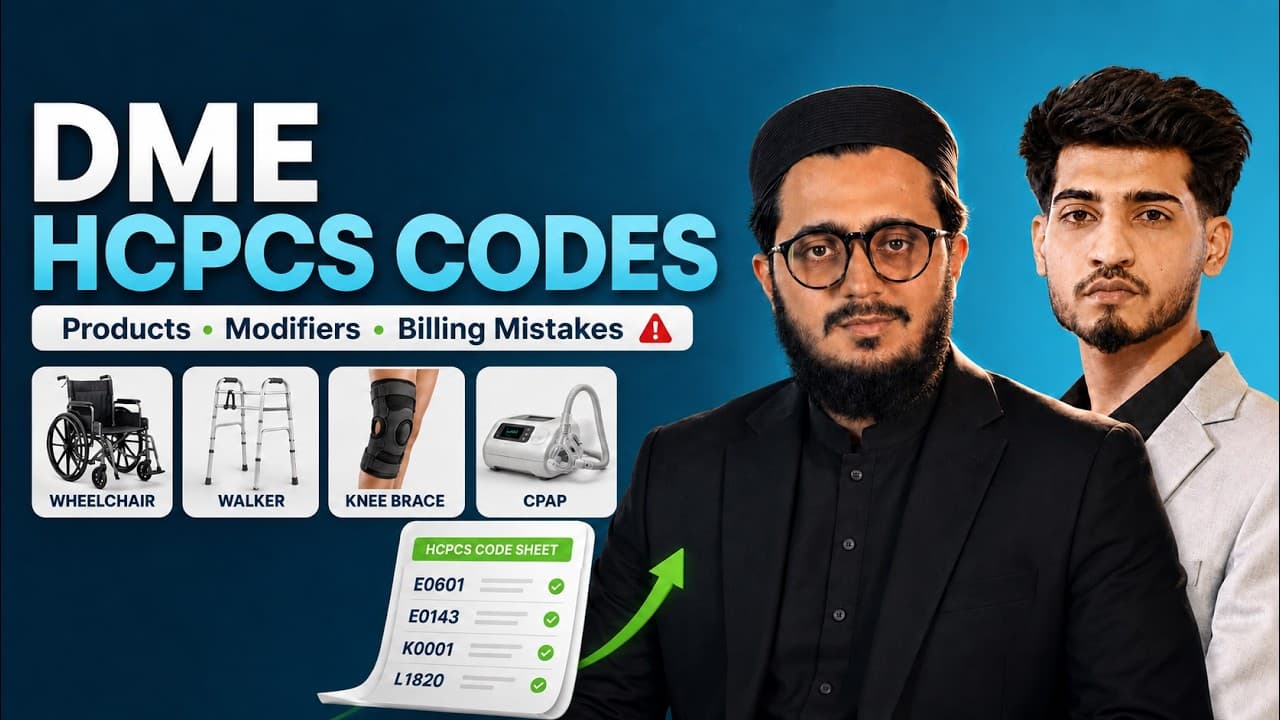
Durable medical equipment (DME) is equipment such as wheelchairs, walkers, hospital beds and nebulizers that a doctor orders for a patient to use at home, and DMEPOS widens the term to prosthetics, orthotics and supplies. This first lesson of the NextRCM DME course follows a DME order from the doctor's office through insurance checks, documentation, delivery, billing and payment, and names the documentation gaps and compliance risks that lead to denials.
Chapters
Select a chapter to play the lesson from that point.
- 0:00Introduction and course plan
- 1:28What DME is
- 2:00How a DME order works
- 6:02Documentation, medical necessity and audit risk
- 9:01What counts as DME, and accreditation
- 11:06Common DME products
- 12:37DME vs DMEPOS
- 13:31Doctor order to insurance payment flow
- 16:06Stakeholders in the DME industry
- 18:31Who pays for DME
- 20:36Documentation basics: order, chart notes and diagnosis
- 26:12DME billing basics: codes, claims and remittance
- 30:00Common DME risks
- 33:20DME team roles and career paths
- 35:31What the course will cover next
Full transcript
English translation of the Urdu and Hindi audio, taken from the English captions published with this video on YouTube. The captions for this lesson condense the spoken audio, so the transcript is shorter than the lesson itself.
Show the full transcript (1,290 words)
0:00Introduction and course plan
In the name of Allah, the Most Gracious, the Most Merciful. Assalamu Alaikum wa Rahmatullahi wa Barakatuh. I hope you are all doing well. My name is Usman Shamsi, and I have prepared a course about DME, Durable Medical Equipment. I have been learning and working around the U.S. healthcare industry for quite some time, and I decided to organize what I have learned into a complete course. This course is planned to include around 15 to 20 videos. The first few videos will cover the basics, and then we will go deeper into the industry step by step.
If you have any questions, please ask them in the comments. InshaAllah, I will try my best to answer everyone. So, what is Durable Medical Equipment? In simple words, just like a pharmacy has medicines and drugs, a DME store has durable medical products.
1:28What DME is
Examples include wheelchairs, rollators, incontinence supplies, hospital beds, catheters, nebulizers, oxygen supplies, urological supplies, canes, and crutches.
2:00How a DME order works
How does a DME store work? A patient visits a doctor’s office, the doctor evaluates the patient, and if needed, the doctor prescribes DME through an order or referral. Doctor offices usually have referral coordinators. They send the order to a DME company that is contracted or partnered with them. Our company works in revenue cycle management and also manages DME operations. For example, if a patient has a fall risk, the doctor may prescribe a wheelchair. If the patient had surgery or needs urological support, the doctor may prescribe related supplies.
If a patient is discharged home and needs a hospital bed, the doctor may prescribe it, but insurance coverage depends on medical necessity, eligibility, and payer-specific criteria. When the DME company receives the order, it first performs intake, checks patient eligibility, reviews coverage, checks same or similar items, and verifies patient responsibility. If the patient has secondary insurance, the secondary plan may cover the remaining responsibility. The team also confirms sizing, documentation, and address details before delivery. In DME, billing usually happens after the service is rendered. If prior authorization is required, it must be obtained before delivery.
After delivery, the claim is submitted using the appropriate claim form or electronic claim. Another important step is to ask satisfied patients for reviews, such as on Google Business Profile or other social platforms, so the DME company can build credibility. DME is not just equipment. It is a complete structure: doctor order, insurance coverage, documentation, medical necessity, delivery proof, billing, and compliance.
6:02Documentation, medical necessity and audit risk
Documentation may include chart notes, progress notes, prior authorization, and in some cases an ABN, which stands for Advance Beneficiary Notice. Proof of Delivery is also very important. Many DME providers use vendors like McKesson, Cardinal, DDP, or Drive Medical. The tracking and delivery information should be saved as Proof of Delivery for audits and denials. In billing, the claim includes patient demographics, diagnosis codes, HCPCS codes, authorization information, and other claim details. Compliance is extremely important because weak documentation can lead to recoupments. Durable Medical Equipment means equipment that can be used repeatedly, serves a medical purpose, and is usually used in the patient’s home. Medicines and regular drugs do not fall under DME.
9:01What counts as DME, and accreditation
Some nutrition-related products can be billed in certain DME categories, but the supplier must have the correct accreditation and enrollment setup. We will discuss accreditation in detail later. DME products help patients manage medical conditions. For example, a continuous glucose monitor can help a diabetic patient track sugar levels, and mobility equipment can help patients move safely at home. Most DME products are for home use. Usually, the doctor prescribes the item based on the patient’s condition, and the referral coordinator sends the order to the DME company.
11:06Common DME products
Common DME categories include wheelchairs, walkers, hospital beds, oxygen equipment, CPAP and BiPAP devices, braces, wound care supplies, catheters, ostomy supplies, and diabetic supplies. DME means Durable Medical Equipment. DMEPOS means Durable Medical Equipment, Prosthetics, Orthotics, and Supplies. Supplies include wound care, ostomy, diabetic, and similar categories.
12:37DME vs DMEPOS
The DME workflow starts with patient need, doctor evaluation, DME order, eligibility check, documentation review, prior authorization if needed, delivery, Proof of Delivery, claim submission, and then payment or denial.
13:31Doctor order to insurance payment flow
If a claim is denied, we need to understand why. In future videos, we will cover the common DME denial reasons in detail and explain how to handle them properly. The main stakeholders in DME include the patient, doctor office, referral coordinator, DME supplier, insurance payer, billing team, vendor, delivery team, and compliance team.
16:06Stakeholders in the DME industry
Major payer types include Medicare, Medicaid, and private insurance companies such as UnitedHealthcare, Blue Cross Blue Shield, Aetna, Humana, and others. Vendors and distributors also play an important role. DME companies may buy or ship products through vendors based on price, availability, credit line, and product type. Medicare is a federal health insurance program. Medicaid is a state-administered program with federal support. Medicare Advantage plans are Medicare plans offered through private insurance companies.
18:31Who pays for DME
Medicare Advantage plan types include HMO, PPO, EPO, and LPPO. Secondary insurance, supplements, and Medigap plans may help cover deductibles, coinsurance, and other patient responsibilities.
20:36Documentation basics: order, chart notes and diagnosis
Documentation is the backbone of DME. A doctor order usually includes provider information, patient demographics, diagnosis, the prescribed DME item, signature, and date. Orders may expire and may need renewal, especially for recurring supplies. Chart notes or progress notes explain the patient’s condition, assessment, treatment plan, vitals, and medical need. Prior authorization is submitted to the insurance company with supporting clinical documentation. If approved, the payer provides an authorization number that is used on the claim. For recurring supplies, continued need and continued use are important. This may apply to catheters, incontinence supplies, diabetic sensors, compression stockings, and other ongoing supplies.
Diagnosis codes are called ICD-10 codes. They classify diseases and medical conditions. Correct diagnosis coding helps connect the patient’s condition with the DME item. Medical necessity means the patient clinically needs the item according to the payer’s policy. If medical necessity is weak, the item may be denied or later recouped after an audit. If coverage criteria are not met, the patient may need updated documentation from the doctor or may choose to purchase the product out of pocket. Proof of Delivery should always be saved. DME billing uses HCPCS codes, ICD-10 diagnosis codes, and modifiers. HCPCS codes identify products and services. Modifiers may show rental, new equipment, used equipment, left side, right side, and other details.
26:12DME billing basics: codes, claims and remittance
The CMS-1500 form or electronic 837P claim includes patient demographics, diagnosis codes, HCPCS codes, modifiers, authorization numbers, and billing details. EOB means Explanation of Benefits, and ERA means Electronic Remittance Advice. Common DME risks include missing orders, weak medical necessity, no prior authorization, missing Proof of Delivery, wrong HCPCS codes, wrong modifiers, and same or similar issues.
30:00Common DME risks
Misleading marketing is a major compliance risk. Improper lead generation, fake signatures, edited chart notes, routine copay waivers, and unnecessary products can create serious problems for a DME supplier. If a payer later finds that documentation or medical necessity was not valid, the payment may be taken back through overpayment recovery or recoupment. Career roles in DME include intake specialist, eligibility specialist, prior authorization specialist, DME biller, AR specialist, denial manager, credentialing specialist, patient coordinator, and referral coordinator.
33:20DME team roles and career paths
In small DME companies, one person may handle many tasks: intake, eligibility, billing, prior authorization, AR, denial management, patient coordination, credentialing, and referrals. In this course, we will cover DME history, market size, NPI, PTAN, accreditation, eligibility, benefits, documentation, denial management, recurring supplies, Medicare, Medicaid, commercial insurance, products, codes, prior authorization, CMS-1500, patient coordination, marketing, referrals, compliance, and audits.
35:31What the course will cover next
In the next video, we will discuss the history of DME and the market size in the USA. Please share your recommendations in the comments. JazakAllah Khair. Assalamu Alaikum wa Rahmatullahi wa Barakatuh.
General education, not legal, billing or coverage advice. Rules vary by payer, plan, state and date of service, and they change, so check current CMS and payer guidance before acting.
The same topic in writing
More video lessons


Want a team that already works this way?
NextRCM runs DME billing, eligibility, prior authorization, credentialing and audit preparation for U.S. suppliers and practices. Tell us where your revenue cycle is stuck.