
Healthcare and DME billing scams: the red flags we see
Most billing scams that hurt providers share one design: someone else runs the patients, the orders and the money, while your LLC, NPI or bank account carries the liability. This guide covers the schemes we keep seeing in messages from business owners and viewers of our video lessons, the federal rules they break, ten questions to ask before you sign anything, and what to do if you are already involved.
General information, not legal advice. Every rule and figure links to its primary source.
Six schemes that keep coming back
The names change; the mechanics do not. Each one keeps the operator out of sight and leaves the enrolled owner holding the claims.
The "use your LLC" billing partnership
A call center offers the owner of a U.S. LLC 20 to 30 percent of collections to bill DME through the company. The operator calls patients directly, waives the 20 percent coinsurance to get a yes, sends prescriptions to busy doctors' offices to sign, and bills before delivery, sometimes for items that never ship. Orders, chart notes, face-to-face notes and proof of delivery are often made up. When audits and overpayment letters arrive, they go to the LLC owner: in the cases people have shared with us, recoupments ran from $100,000 to $1 million, and the money had already left.
Red flag: Anyone asking to use your LLC, NPI or bank account to bill in exchange for a share of the collections.
Billing on a Type 2 NPI with no Medicare enrollment
An LLC gets a Type 2 NPI with a long list of taxonomy codes, skips Medicare enrollment, and bills Medicare Advantage and commercial plans for patients found through cold-calling lead lists. When prepayment reviews and recoupment letters start, the operator walks away from the company. The recovery demands still go to the owner on file.
Red flag: "We'll set up a DME on your LLC and bill on a Type 2 NPI."
Buying, selling or passing orders
A "marketing partner" sells a supplier orders or patient leads at a price per order, or markets under one supplier's name and passes the orders to another. The leads usually start with calls to Medicare patients. Paying for referrals of federal health care program business can be a felony under the Anti-Kickback Statute, and supplier standards bar most unsolicited calls to Medicare beneficiaries.
Red flag: A price per order, per patient or per lead.
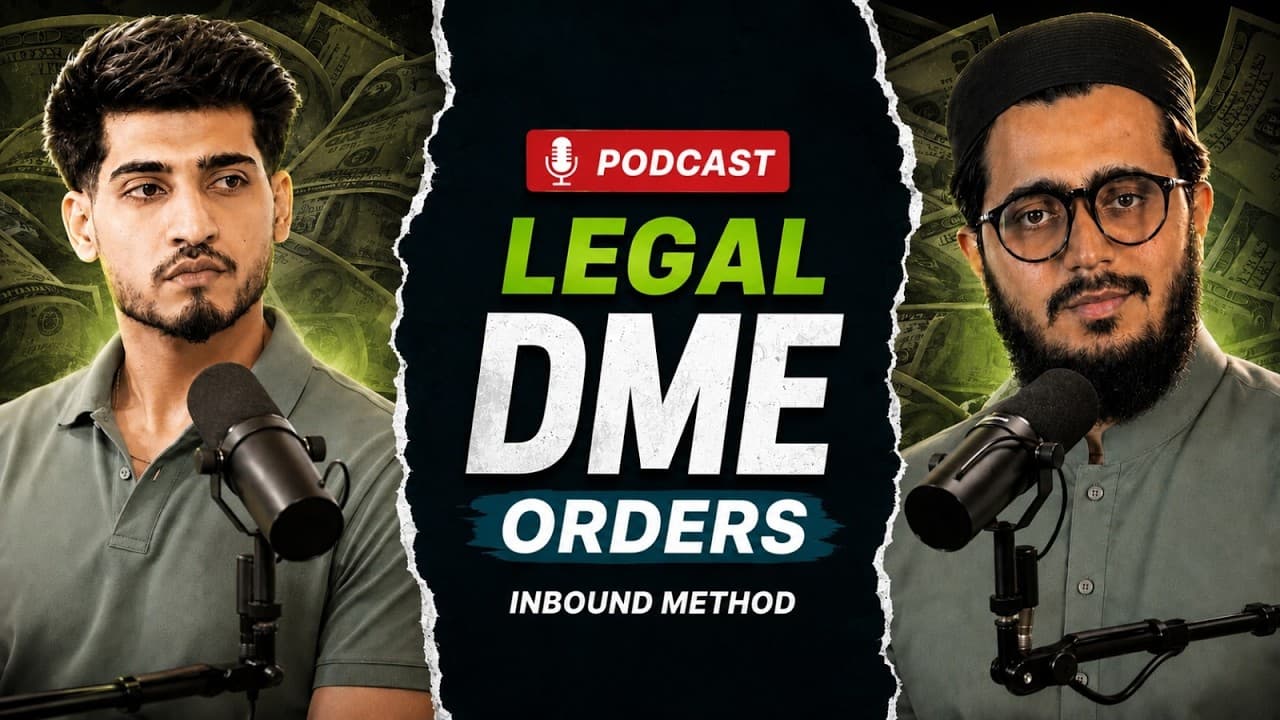
Sources: Video lesson: legal inbound marketing for DME orders · 42 U.S.C. 1320a-7b(b) (opens in a new tab)
Telemedicine and "chart review" order mills
A company recruits patients through calls or ads, then pays a clinician by the order to sign DME, genetic test or lab orders after little or no contact with the patient. HHS-OIG lists the warning signs: patients recruited by the company, too little contact to judge medical necessity, pay tied to the number of orders, and a single product line. In June 2026, DOJ reported the arrest of a fugitive tied to a $1.2 billion telemedicine and DME scheme.
Red flag: Orders signed by a clinician the patient has never seen.
Sources: HHS-OIG Special Fraud Alert, July 20, 2022 (opens in a new tab) · DOJ, June 23, 2026 (opens in a new tab)
Front owners and shell companies
A supplier is bought or set up with a "nominee" owner on paper, bills hard for a short time, and disappears before audits catch up. In Operation Gold Rush, DOJ alleged that one transnational organization bought dozens of DME companies, paid people to act as nominee owners, used the stolen identities of more than one million Americans, and submitted over $10.6 billion in false Medicare claims. In June 2026, DOJ announced charges for an additional $3.7 billion in claims tied to the same scheme, for urinary catheters and other equipment that was never provided.
Red flag: An offer to put your name on a company that someone else will run.
Sources: DOJ 2025 takedown case summaries (opens in a new tab) · DOJ, June 23, 2026 (opens in a new tab)
Schemes that move to the next product
When CMS tightens one product, the same playbook moves to another. We have started seeing posts like "I need an LLC to set up a lab and bill," because tests are high dollar and can be billed again and again. Wound care is another: DOJ described kickback-driven billing of amniotic allografts, with one company's products billed to Medicare for more than $4 billion from December 2021 to June 2024. CMS cut the payment to $127 per square centimeter from January 1, 2026.
Red flag: A partner who needs your LLC for a product line you have never run.
Sources: Video lesson: how LLC owners get trapped · DOJ, June 23, 2026 (opens in a new tab)
Scams that target your practice directly
These do not need your cooperation. They need one rushed staff member, one unverified fax, or one enrollment record nobody checks.
Payment diversion
Criminals phish staff logins, talk an IT help desk into resetting multifactor login, then change ACH or EFT details so payer payments land in their own account. In one case the FBI described, about $840,000 was diverted in two transactions before anyone noticed.
What helps
Use multifactor login on every account, never let the help desk reset it for a caller (FBI and HHS advice), and confirm any bank change by calling a number you already have on file.
Sources: FBI and HHS advisory, June 24, 2024 (opens in a new tab) · FBI notice, September 14, 2022 (opens in a new tab)
Fake audit and records requests
Scammers fax requests that look like they come from CMS or a contractor, claim a Medicare audit, and ask for medical records. CMS has warned that it does not start audits by requesting medical records by fax.
What helps
Do not answer the fax. Confirm the request with your Medical Review Contractor, using contact details from its official website.
Sources: CMS alert, republished by CGS, June 30, 2025 (opens in a new tab)
NPI and enrollment hijacking
A provider's identity can be used to open a new Medicare enrollment, add a reassignment, or switch the EFT account on an existing number. The overpayments, and eventually Treasury debt, can land on the real provider.
What helps
Check your PECOS and NPPES records and your remittances regularly, act on anything you did not file, and report it. Medicare's program integrity contractors run a process that can relieve a confirmed victim of the liability.
Sources: Medicare Program Integrity Manual, ch. 4, §4.7.2.1 (opens in a new tab)
What NextRCM will not do
We run billing, credentialing and growth work for DME suppliers and practices. These are the lines we hold, whoever asks.
- We work only for the enrolled supplier or practice, never for an operator billing through someone else's LLC or enrollment.
- We do not buy, sell or broker orders or patient leads, and we do not pay or accept referral fees.
- We do not bill an item before it is delivered, or without the order and records the payer requires.
- We do not create, edit or sign orders, chart notes or delivery records. Those come from the clinician and the supplier.
- We do not cold-call Medicare patients. Growth work for our DME clients runs through referral sources such as practices, agencies and facilities.
Ten questions to ask any billing "partner"
If an offer cannot answer these in writing, walk away, or have a healthcare attorney read it before you sign.
- Whose name is on the enrollment, and whose bank account receives the payments?
- Can you see every claim, remittance and payer portal yourself, with your own login?
- Where do the patients and orders come from? Does anyone call Medicare patients who did not ask?
- How is each marketer, rep or partner paid: a salary, a fixed fee, or an amount per order?
- Is the patient's coinsurance collected, or "waived" to win the order?
- Has the ordering clinician actually seen and treated the patient?
- Is each item delivered, with proof of delivery, before the claim goes out?
- Is the company accredited for every product category it bills?
- Will anyone else bill under your NPI, PTAN or supplier number?
- Does a written U.S. contract say who repays an overpayment or a recoupment?
What to do if you are already in one
Move quickly, in this order. Going it alone or deleting records usually makes it worse.
Stop the billing
Stop new claims through the arrangement and take back every login: payer portals, the clearinghouse, EFT enrollment and email.
Keep every record
Save contracts, chats, claims, remittances and delivery records. Do not delete anything.
Talk to a healthcare attorney
Get independent legal advice before you answer auditors, payers or the other party.
Watch the 60-day clock
Once an overpayment is identified, Medicare's rule gives 60 days to report and return it. A timely, good-faith investigation can suspend that deadline for up to 180 days.
Ask about self-disclosure
Ask your attorney whether the HHS-OIG Provider Self-Disclosure Protocol fits your situation. A submission OIG acknowledges also suspends the 60-day deadline.
Report it
Report health care fraud, including misuse of your NPI, to the HHS-OIG hotline, and payment diversion or account takeover to the FBI's Internet Crime Complaint Center.
Report to HHS-OIG (opens in a new tab)Report to the FBI (IC3) (opens in a new tab)
The federal rules these schemes break
Paying for referrals can be a felony
Knowingly and willfully paying or receiving anything of value for referrals of federal health care program business is a felony, with fines up to $100,000 and prison up to 10 years.
Source: 42 U.S.C. 1320a-7b(b)
Employees are the clear safe harbor
Pay to a bona fide employee for work on federal program items is not "remuneration" under the Anti-Kickback Statute. Per-order commissions to independent marketers fall outside this safe harbor, so have any such deal reviewed by counsel.
Source: 42 CFR 1001.952(i)
Routine coinsurance waivers are inducements
Offering Medicare or Medicaid patients anything of value that is likely to influence their choice of supplier can bring civil monetary penalties, and a waived coinsurance counts. The exception is narrow: not advertised, not routine, and based on financial need or failed collection efforts.
No unsolicited calls to Medicare patients
A DMEPOS supplier may not call a beneficiary about a Medicare-covered item unless the beneficiary gave written permission, the call coordinates delivery of an item already furnished, or, for a different item, the supplier furnished a covered item to that person in the previous 15 months.
Source: 42 CFR 424.57(c)(11)
A supplier number cannot be lent or sold
Every Medicare DMEPOS supplier agrees not to convey or reassign its supplier number.
Source: 42 CFR 424.57(c)(18)
Fax marketing needs a relationship first
An unsolicited fax advertisement is allowed only with an established business relationship, a fax number the recipient made available, and an opt-out notice on the first page.
Source: 47 CFR 64.1200(a)(4)
Overpayments have a deadline
An identified overpayment must be reported and returned within 60 days. A timely, good-faith investigation, or a self-disclosure that OIG or CMS acknowledges, suspends the deadline.
Source: 42 CFR 401.305
OIG's telemedicine warning signs
HHS-OIG lists the suspect features of order-signing arrangements: recruited patients, limited contact, pay tied to order volume, and a single product line such as DME or genetic tests.
General information, not legal advice. Rules were checked against the linked sources on November 25, 2026; payer contracts and state law can add more. Talk to a healthcare attorney before you act on a specific arrangement.
Watch the lessons
Free lessons with chapters and a full English transcript.



Healthcare scam questions
Still have a question? Talk to our team and we'll walk through your specific situation, no pressure and no patient data needed.
Get a consultationHiring a billing company is normal, but you must stay in control: the patients, orders, deliveries and money are yours, and you answer for every claim. When an outside operator runs those things through your enrollment, the audits, recoupments and penalties still come to you. Medicare also bars suppliers from conveying or reassigning a supplier number. Have a healthcare attorney read any such offer before you sign.
Build it the compliant way
Guides and services for setting up, growing and defending a DME supplier or practice without shortcuts.
Got an offer that feels wrong?
Talk to us before you sign. A free consultation covers how a compliant DME or billing setup works and where offers like yours usually go wrong. Business details only, never patient information.